15th Post – Don’t think just shoot M1
14 years ago

 Download
Mod (originally modernist, sometimes capitalised) is a subculture that originated in London in the late 1950s and peaked in the early to mid 1960s.[1][2][3]
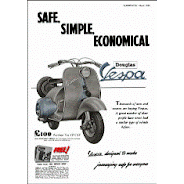
Significant elements of the mod lifestyle included pop music, such as African American soul, Jamaican ska, and British beat music and R&B; fashion (often tailor-made suits); and Italian motor scooters. The mod scene was also associated with amphetamine-fuelled all-night dancing at clubs.[4] The mod scene developed when British teenagers began to reject the "dull, timid, old-fashioned, and uninspired" British culture around them, with its repressed and class-obsessed mentality and its "naffness" [5]. From the mid to late 1960s onwards, the mass mediamod in a wider sense to describe anything that was believed to be popular, fashionable or modern. often used the term
There was a mod revival in the United Kingdom in the late 1970s, which was followed by a mod revival in North America in the early 1980s, particularly in Southern California.[6][7]
The term mod derives from modernist, which was a term used in the 1950s to describe modern jazz musicians and fans.[8] This usage contrasted with the term trad, which described traditional jazz players and fans. The 1959 novel Absolute Beginners by Colin MacInnes describes as a modernist a young modern jazz fan who dresses in sharp modern Italian clothes. Absolute Beginners may be one of the earliest written examples of the term modernist being used to describe young British style-conscious modern jazz fans. The word modernist in this sense should not be confused with the wider use of the term modernism in the context of literature, art, design and architecture.
Rawlings claims that the mod scene developed when British teenagers began to reject the "dull, timid, old-fashioned, and uninspired" British culture around them, with its repressed and class-obsessed mentality and its "naffness" [5]. Mods rejected the "faulty pap" of 1950s pop music and sappy love songs. They aimed at being "cool, neat, sharp, hip, and smart" by embracing "all things sexy and streamlined", especially when they were new, exciting, controversial or modern. They watched French and Italian art films and read Italian magazines to look for style ideas.[5][9]. Hebdige argues that the mod subculture only gradually accumulated the identifying symbols that later came to be associated with the scene, such as scooters, amphetamine pills, and music.[9] He claims that the mod subculture came about as part of the participants' desire to understand the "mysterious complexity of the metropolis" and to get close to black culture of the Jamaican rude boy, because mods felt that black culture "ruled the night hours" and that it had more streetwise "savoir faire".[10] Dick Hebdige claims that the "progenitors of this style appear to have been a group of working-class dandies, possibly descended from the devotees of the Italianite [fashion] style" in the UK.
Shari Benstock and Suzanne Ferriss argue that at the "core of the British Mod rebellion was a blatant fetishizing of the American consumer culture" that had "eroded the moral fiber of England." They claim that UK mods were "worshipping leisure and money... scorning the masculine world of hard work and honest labour" by spending their time listening to music, collecting records, socializing, and dancing at all-night clubs.[11] In doing so, the mods "mocked the class system that had gotten their fathers nowhere", and created a "rebellion based on consuming pleasures" ranging from Italian suits and scooters to US soul records. Benstock and Ferriss claim that the emphasis in the mod subculture on consumerism and shopping was the "ultimate affront to male working-class traditions" in the UK, because in the working-class tradition, shopping was usually done by women.[12]
While several historians and cultural theorists, including Hebdige,[13] have argued that mods had originated from working class families, Mary Anne Long argues that they were mistaken in making assumption, which she argues that Dick Hebdige and others made due to their structuralist ideology. She claims that "first hand accounts and contemporary theorists point to the Jewish upper-working or middle-class of London’s East End and suburbs". Long cites an interview with Steve Sparks, who claims that he was "one of the original mods, one of the real Wardour Street mods. Not the post-commercialized mods". He argues that "Mod has been much misunderstood... as this working-class, scooter-riding precursor of skinheads." Sparks claims that before mod was commercialized, it was essentially an extension of the beatniks. "It comes from ‘modernist’, it was to do with modern jazz and to do with Sartre" and existentialism. [14]
UK sociologist Simon Frith asserts that the mod subculture had its roots in the 1950s beatnikbohemian scene in London.[15] Coffee bars were attractive to youths, because in contrast to typical UK pubs, which closed at about 11 pm, they were open until the early hours of the morning. As well, coffee bars had jukeboxes, which in some cases reserved some of the space in the machines for the students' own records. Although coffee bars were associated with jazz and blues music during the late 1950s beatnik and bohemian era, in the early 1960s, they began playing more R&B music. Although coffee bars were aimed at middle-class art school students, Frith notes that coffee houses eventually created an intermixing of youths from different backgrounds. He points out that a coffee bar near Ealing College attracted both well-off art school students and working-class mods from the adjoining catering and commercial colleges[16]At these venues, which Frith calls the "first sign of the youth movement", youths would meet R&B and blues record collectors, who introduced them to new types of African-American music, which the teens were attracted to for its rawness and authenticity. coffee bar culture, which catered to art school students in the radical
Mods were the products of a culture of constant change, and by the time Bobby Moore held the World Cup aloft in the summer of 1966, the mod scene was in sharp decline. Dick Hebdige argues that the mod subculture eventually lost its vitality when it became commercialized and made artificial and stylized, to the point that new mod clothing styles were being manufactured "from above" by clothing companies and by TV shows like Ready Steady Go!, rather than being created by young scene members customizing their clothes and mixing different fashions together [17].
As psychedelic rock music and the hippie subculture became popular in the UK, many people drifted away from the mod lifestyle. Bands such as The Who and Small Faces had changed their musical styles and no longer considered themselves mods. Another factor was that the original mods of the early 1960s were getting into the age of marriage and child-rearing, which meant that they no longer had the time or money for their youthful pastimes of club-going, record-shopping and scooter rallies. The "peacock" or "fashion" wing of mod culture evolved into the Bohemian style of London hippie culture, which favored the gentle, marijuana-infused contemplation of esoteric ideas and aesthetics, which contrasted sharply with the frenetic energy of the mod ethos.

In the mid- to late 1960s, the mod subculture continued, albeit with many changes, as the hard mod subculture.[18][19][20][21] Hard mods often lived in the same economically depressed areas of South London where West Indian immigrants lived, and the hard mods emulated the rude boypork pie hats and too-short Levis jeans.[22] White hard mods began listening to Jamaican ska and going to black nightclubs like Ram Jam. Dick Hebdige claims that the hard mods were drawn to black culture and ska music in part because the educated, middle-class hippie[23] He argues that the hard mods were also attracted to ska because it was a secret, underground, non-commercialized music that was disseminated through informal channels such as house parties and clubs.[24] look of movements' drug-oriented and intellectual music did not have any relevance for them.
The hard mods soon transformed into the first skinheads, a non-political subculture of "aspiring 'white negros'" who mingled with black rude boy youths and danced the shuffle to ska in West Indian clubs such as A-Train and Sloopy's.[25][26][27] The early skinheads retained basic elements of mod fashion — such as Fred Perry and Ben Sherman shirts, Sta-Prest trousers and Levi's jeans — but mixed them with working class-oriented accessories such as braces and Dr. Martens work boots. Hebdige claims that as early as the Margate and Brighton brawls between mods and rockers, some mods were seen wearing boots and braces and sporting close cropped haircuts, which "artificially reproduces the texture and appearance of the short negro hair styles" (though this was as much for practical reasons, as long hair was a liability in industrial jobs and streetfights).[22] The early skinheads kept some of the original mod music styles alive; specifically ska, soul, rocksteady and early reggae.
Mods were also part of the northern soul scene, a subculture based on obscure 1960s and 1970s American soul records. Eventually, mods evolved into, or merged with, other subcultures such as individualists, stylists, and scooterboys, creating a mixture of "taste and testosterone" that was both self-confident and streetwise.[5]



 Posts
All Comments
Posts
All Comments